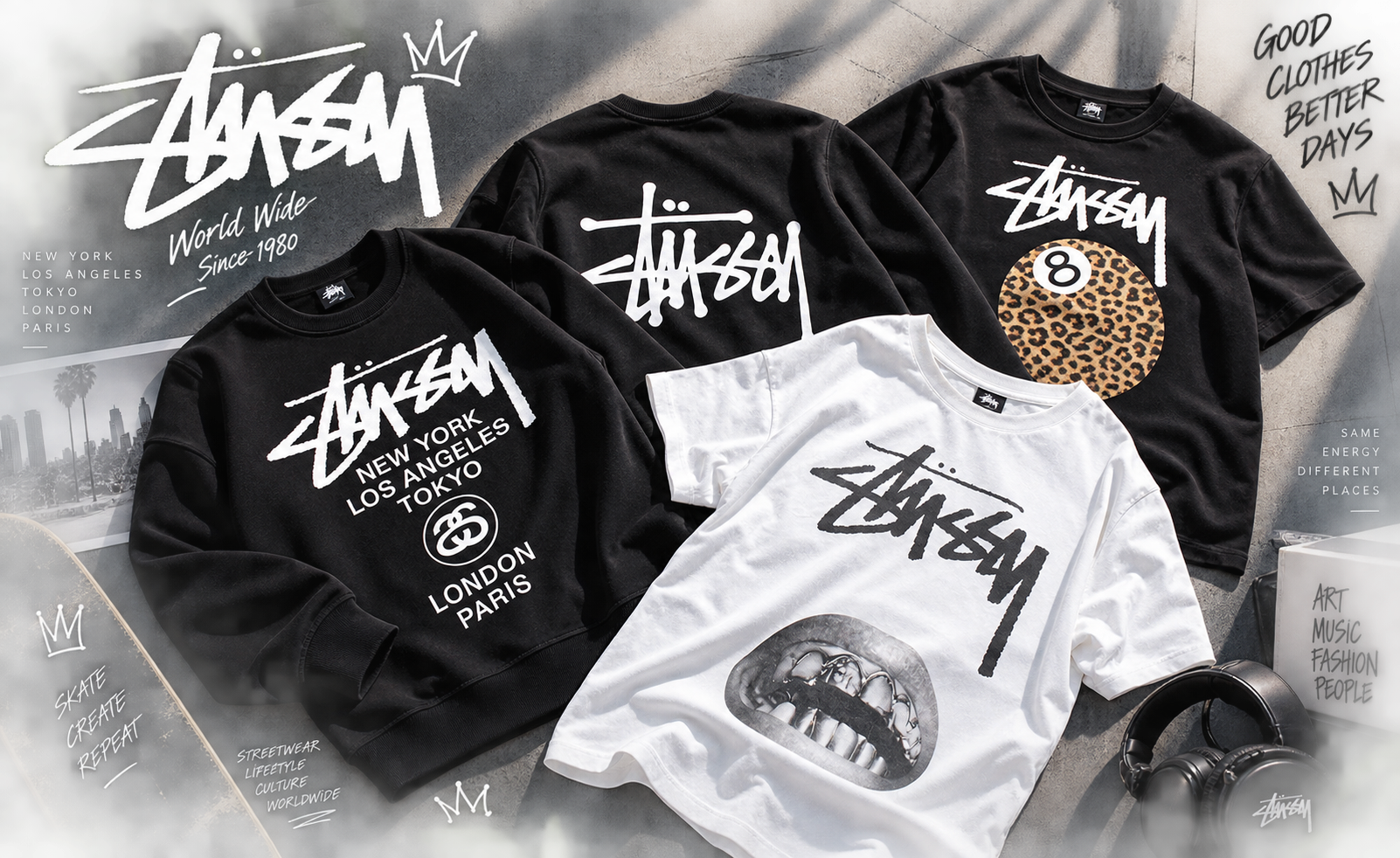
Stussy vs Supreme is the streetwear comparison that surfaces more than any other. Both brands sit at the centre of the culture. Both have heritage that predates most of their competitors by decades. Both produce graphic-led clothing that communicates identity before anything else. But they operate on fundamentally different models, and the right choice depends entirely on what you want from the purchase.
This page compares them directly across quality, availability, resale, and cultural positioning for buyers in both the UK and USA. For the full Stussy brand overview including sizing and where to buy, see our complete Stussy clothing guide. What follows here is a straight comparison without brand loyalty in either direction.
Two Brands, One Origin Point
The connection between Stussy and Supreme is not casual. It is direct and documented.
Stussy launched in the early 1980s when Shawn Stussy began printing his signature on T-shirts to promote his surfboard shaping operation in Laguna Beach, California. By the late 1980s, the International Stussy Tribe had embedded the brand in skate, hip-hop, rave, and club culture across New York, London, Tokyo, and Los Angeles without conventional marketing.
In 1991, Shawn Stussy and James Jebbia opened the first Stussy flagship store together in SoHo, New York. Jebbia observed how the community-first, limited-distribution model worked at Stussy, then left to found Supreme in 1994. (cite index=”51-1″>Supreme opened as a small New York City skate shop in 1994 and turned limited drops into a cultural event. Its red box logo is one of the most recognised marks in the category.</cite>
The two brands share a direct lineage. Supreme took Stussy’s community-driven approach and built a different machine around it: one defined by deliberate scarcity, weekly drops, and a resale economy that generates multiples of the original retail value. Stussy kept the approach that Supreme left behind: consistent availability, broader stockist networks, and a product focus that prioritises wearability over collectability
Quality: How the Products Actually Compare
(cite index=”52-1″>Supreme sources heavier fleece for many of its hooded sweatshirts, with certain styles reaching 600gsm or more in weight.</cite> Stussy’s mainline hoodies run from 380gsm on the Stock Lock to 450gsm on the 8 Ball Hoodie Pigment Dyed. At the top end of Supreme’s range, the fabric is denser and heavier than Stussy’s heaviest offering.
But fabric weight alone does not determine overall quality. (cite index=”52-1″>Independent assessments across UK streetwear communities frequently note that Stussy delivers comparable build quality for roughly half the cost of Supreme’s equivalent pieces.</cite)
(cite index=”52-1″>Supreme’s crossgrain weave resists shrinking, which is a significant practical advantage.</cite> Stussy’s 100% cotton mainline hoodies require careful cold washing and flat drying to avoid shrinkage. Supreme’s construction is more forgiving of imperfect care. That engineering advantage is real, not marketing.
On tees, the quality gap is narrower. Both brands use heavyweight cotton in the 200gsm to 220gsm range with screenprinted graphics. (cite index=”55-1″>Stussy’s quality can vary on Supreme’s side. Sometimes stellar. Sometimes questionable, especially on resale markets.</cite> The consistency of Stussy’s mainline tee quality is arguably more reliable than Supreme’s, where quality fluctuates between seasonal drops and collaborative pieces.
My honest assessment: Supreme wins on maximum fabric weight at the top of its range. Stussy wins on quality consistency across the full product line. Neither is categorically better. They optimise for different things.
Availability: A Completely Different Buying Experience
This is where the two brands diverge most dramatically, and it is the most practical factor for most buyers.
(cite index=”50-1″>Stussy is comparatively easily available in almost all designs compared to Supreme.</cite> Stussy operates a global stockist network that includes End Clothing, Dover Street Market, SSENSE, Bodega, Goodhood, Size?, and Flatspot. New drops land on Fridays at 10:00 AM GMT, and while popular pieces sell through quickly, core product (logo tees, basic hoodies, hats) remains available through stockists for days or weeks after a drop.
Supreme’s UK access centres on the London Chapter store in Soho plus a weekly Thursday online drop at 11:00 AM GMT during the season. There is no broad stockist network for current-season product. If you miss the Thursday window, your options are resale or nothing. The online drops sell out most items within seconds due to automated purchasing software competing against manual buyers.
For US buyers, Supreme’s physical retail includes the Lafayette Street store in New York and the Fairfax Avenue location in Los Angeles. The online drop runs simultaneously for US buyers. The bot competition problem is identical.
(cite index=”50-1″>Some people prefer Stussy because it is more appealing and attention catching. It is also preferred by people who like the designs to be more detail oriented.</cite>
For a buyer who wants to wear streetwear regularly without treating purchasing as a competitive event, Stussy is dramatically more accessible. You can browse Stussy tees and shirts at your convenience rather than competing in a ten-second window against bots.
Resale: Two Completely Different Markets
Supreme wins the resale conversation without contest. But that victory comes with important context.
(cite index=”53-1″>Resale markets in the UK push Supreme hoodies considerably further, sometimes reaching three to four times the original retail cost.</cite> A Supreme box logo hoodie that sells at retail can appear on StockX for two to five times that amount within 24 hours. Certain collaborative pieces, the Louis Vuitton partnership from 2017 being the extreme example, have appreciated dramatically over time.
Stussy mainline pieces do not generate comparable resale premiums. A standard Stussy 8 Ball tee purchased at retail will resell at approximately the same amount or a modest premium in good condition. Collaborative drops with Nike, Comme des Garcons, or Our Legacy carry slightly higher resale returns, but nothing approaching Supreme’s multiples.
The honest framing: if you are buying streetwear as a wearable purchase, Stussy’s cost-per-wear calculation is significantly better because you paid retail, not resale. If you are buying streetwear with an investment component, Supreme’s limited pieces have a track record that Stussy does not match.
Cultural Positioning: What Each Brand Says About You
(cite index=”51-1″>Stussy is a foundational streetwear brand with a relaxed, California surf-inspired style, offering timeless and more widely available pieces. Supreme is a New York-based powerhouse defined by hype, scarcity, and its iconic box logo, creating high-demand collectibles through weekly limited drops.</cite>
Stussy communicates cultural credibility through heritage and consistency. The brand has been present in global street culture for over forty years without relying on artificial scarcity to stay relevant. Wearing Stussy signals a connection to the culture itself rather than to the economics of the drop.
Supreme communicates status and access. Owning a current-season Supreme piece demonstrates that you were either in the right place at the right time or willing to pay the resale premium for the privilege. That signalling is valuable to a specific audience, and Supreme has built a genuine cultural institution around it.
(cite index=”55-1″>Stussy leans timeless and chill. Supreme leans hype and edge.</cite> Neither positioning is better. They serve different needs. The buyer who wants a hoodie they will wear three times a week for two years has a different calculation from the buyer who wants a piece that signals participation in the drop economy.
Who This Comparison Is Not For
If you are deciding between these two brands purely on the basis of which one your friend group wears, this comparison will not help. Social context drives a lot of streetwear purchasing, and no quality or availability analysis overrides that factor.
If you are looking for a brand that fills neither Stussy’s nor Supreme’s specific niche, Carhartt WIP, Palace, and BAPE all occupy adjacent but distinct positions in the market. Our Stussy vs BAPE comparison covers that specific alternative.
If you want technical or performance clothing, neither brand is appropriate. Both produce lifestyle garments from cotton and cotton-blend fabrics.
Final Recommendation
For buyers who want to wear streetwear regularly, who value availability and quality consistency over scarcity and resale returns: Stussy is the more practical and honest choice. The product is accessible, the quality is reliable, and the cultural credibility is earned through forty years of genuine presence rather than manufactured hype.
For buyers who value the drop experience, the collectability of limited pieces, and the cultural signalling that comes with securing something scarce: Supreme delivers something Stussy does not offer and does not attempt to.
Most buyers who care about streetwear end up owning pieces from both brands over time. They fill different roles. Stussy as the wardrobe backbone. Supreme as the occasional statement.
Browse current Stussy graphic tees and the Honolulu collection at StussyStoreCo, where sizing guidance is built into every listing.