Real vs Fake Stussy T-Shirt: How to Spot an Authentic Piece
Introduction
Stussy is one of the most recognised streetwear brands in the world. And unfortunately, that kind of recognition comes with a downside — a lot of fakes. Counterfeit Stussy T-Shirts have been around for years, and some of them look convincing enough to fool people who are not paying close attention.
The good news is that spotting a fake is not as hard as it sounds. Once you know what to look for, the differences become obvious pretty quickly. So in this guide, we are going to walk through every check you need to do — from the logo to the stitching to the tags — so you never get caught out again.
Whether you are buying from a resale platform, a marketplace seller, or even a shop you are not completely sure about — this guide will help you tell the real thing from a copy. And if you want to understand the full range of authentic Stussy T-Shirts before you buy, our complete Stussy T-Shirt guide is a great place to start.
Why Fake Stussy T-Shirts Are Such a Big Problem
Before we get into the checks, it helps to understand why fake Stussy shirts are so common in the first place.
Stussy has been around since the early 1980s. Because of that long history and global recognition, the brand name carries real weight in streetwear culture. People all over the world want to wear it — and that demand creates an opportunity for counterfeiters to make money by selling convincing copies at lower prices.
Also, Stussy’s core designs are relatively simple. A script logo on a plain tee is not the most technically difficult thing to replicate. So fakes can look decent from a distance, even when the details are completely wrong up close.
The result is a market flooded with counterfeit pieces — especially on resale platforms, social media marketplaces, and unofficial online stores. Some fakes are obviously bad. Others are much harder to spot without knowing what to look for.
That is why checking thoroughly before you buy is so important. Because once you have paid for a fake, getting your money back is rarely straightforward.
Where Fake Stussy T-Shirts Are Most Common
Not every place you buy from carries the same risk. So before anything else, it helps to know where fakes tend to show up most often.
Social media marketplaces — Instagram shops, Facebook Marketplace, and similar platforms are high-risk. Because anyone can set up an account and start selling, there is very little quality control. A lot of counterfeit Stussy pieces move through these channels.
Unverified online stores — Any website you have not heard of before that claims to sell Stussy at unusually low prices should immediately raise a flag. If it looks too good to be true, it usually is.
Resale platforms — Platforms like eBay carry more risk than verified streetwear resale sites. However, even on StockX and Grailed, it is worth checking carefully. Both have authentication systems, but nothing is completely foolproof.
Street markets and pop-up stalls — Physical markets are still a common place for counterfeit streetwear to circulate. Without a receipt or a verified seller, there is no comeback if something turns out to be fake.
Reliable sources — StussyStoreCo.com, stussy.com, and authorised stockists like SSENSE and END Clothing are the safest places to buy. When you buy from a trusted source, you do not need to worry about any of this.
How to Spot a Fake Stussy T-Shirt: The Full Checklist
Here is every check you need to do. Go through them in order — and if something feels off at any point, trust that feeling.
Check 1: The Logo
The Stussy script logo is the first thing to look at — and it is often where fakes fall apart immediately.
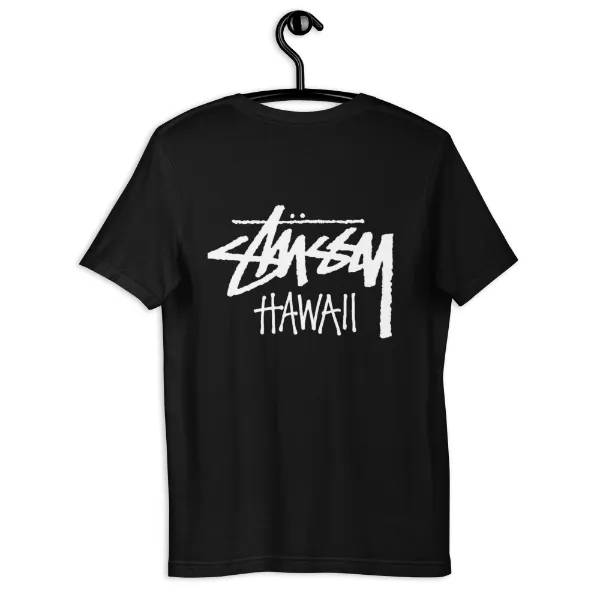
The genuine Stussy logo has a very specific character. The letters have a particular slant, a particular thickness, and a particular flow from one letter to the next. It is Shawn Stussy’s actual handwriting, and it has been consistent across decades. So any small change — even a slightly different angle or a slightly thicker stroke — makes the logo look wrong.
When checking the logo, look for these things specifically:
The letterforms. On a real Stussy T-Shirt, every letter in the script has the same confident, fluid style. On a fake, the letters often look slightly stiff, slightly off in proportion, or just not quite right in a way that is hard to put your finger on. Trust your eye — if it does not look like the logo you have seen a hundred times, something is wrong.
The spacing. The letters in the genuine logo are spaced consistently and flow naturally into each other. On a fake, the spacing is often uneven — some letters too close together, others too far apart.
The print quality. A real Stussy logo is printed cleanly, with sharp edges and consistent ink coverage. On a fake, the print often looks slightly fuzzy at the edges, or the ink coverage is uneven — thicker in some areas, lighter in others.
The colour. The logo colour on a genuine Stussy Shirt is always clean and solid. On a fake, the colour can look slightly off — a white logo that looks more grey, or a black logo that looks faded even on a brand new tee.
Check 2: The Stitching
After the logo, the stitching is the next most reliable indicator of authenticity. And the good news is that stitching quality is very hard to fake well.
On a genuine Stussy T-Shirt, the stitching is clean, even, and consistent throughout. The stitch length is uniform — meaning each individual stitch is the same size as the one next to it. The seams lie flat, and there are no loose threads anywhere.
Here is what to check specifically:
The shoulder seams. Run your fingers along the seams at the top of each shoulder. On a real tee, these seams feel smooth and even. On a fake, you often feel slight bumps or unevenness where the stitching has not been done properly.
The side seams. Look at the seams running down the sides of the tee. On a genuine piece, these are clean and straight. On a fake, side seams are sometimes slightly wavy or misaligned.
The hem. The bottom hem of a real Stussy Shirt is double-stitched and lies completely flat. On a fake, the hem can look uneven or slightly puckered.
Loose threads. A real Stussy tee comes with no loose threads anywhere. If you spot a loose thread on a supposedly new piece, that is a red flag.
Check 3: The Tags
The tags inside a Stussy T-Shirt tell you a lot about whether it is genuine. So take a close look at both the neck label and the care label.
The neck label. On a genuine Stussy Shirt, the neck label is cleanly printed or woven, with sharp text and consistent font sizes. The brand name should look exactly right — same font, same weight, same proportions as you would expect. On a fake, the neck label often has slightly blurry text, unusual fonts, or inconsistent sizing. Sometimes the label fabric itself feels cheap or scratchy in a way that a real Stussy label does not.
The care label. The care label on a genuine piece has all the standard washing and composition information, printed clearly and accurately. On a fake, care labels sometimes have missing information, incorrect washing symbols, or text that does not quite make sense. Also, the composition listed on the care label should be consistent with how the fabric feels. If the label says 100% cotton but the fabric feels synthetic, something is wrong.
The label placement. On a genuine Stussy T-Shirt, the neck label sits centrally and evenly at the back of the collar. If it is slightly off to one side, or if it sits at an odd angle, that is worth noting.
Check 4: The Fabric
The fabric quality of a genuine Stussy T-Shirt is one of the hardest things for counterfeiters to replicate well. Real Stussy uses quality cotton that has a specific weight and feel to it. So the fabric itself is often a reliable indicator.
The weight. A real Stussy tee feels substantial. It is not a thin, flimsy fabric that you can almost see through when you hold it up to the light. Even the lighter-weight tees in their range have a proper body to them. If the fabric feels very thin and cheap, that is a strong warning sign.
The texture. Genuine Stussy cotton has a smooth, consistent texture. It does not feel rough, scratchy, or uneven. Fake tees often use lower-quality cotton blends that feel noticeably different — sometimes rougher, sometimes almost waxy or synthetic.
The drape. When you hold a real Stussy Shirt up and let it hang, it drapes cleanly. The fabric falls evenly and holds its shape. On a fake, the fabric can look slightly limp or misshapen — especially around the collar and shoulders.
Check 5: The Collar
The collar of a Stussy T-Shirt is another area where fakes often give themselves away.
On a genuine piece, the collar is ribbed, cleanly finished, and sits evenly around the neck opening. It has a consistent width all the way around and does not look stretched or distorted. The rib texture is neat and uniform.
On a fake, the collar is often one of the weakest points. It might sit slightly unevenly, feel too stiff or too loose, or have a rib texture that looks inconsistent. Sometimes the collar stretches out easily — which a genuine Stussy collar does not do — because the ribbing quality is lower.
Check 6: The Price
This one sounds obvious, but it is worth saying clearly. A genuine Stussy T-Shirt has a price range — and anything significantly below that range should immediately raise questions.
New Stussy tees retail from around £40 to £90 depending on the style. So if someone is selling a “brand new” Stussy Shirt for £15 or £20, there is almost certainly something wrong. Fakes are priced low because they need to attract buyers who might otherwise pay retail. If the price seems too good to be true, it very likely is.
However, it is also worth noting that a high price does not automatically mean something is genuine. Some sellers price fakes at near-retail levels to make them seem more credible. So always do the full checklist regardless of what someone is asking.
Check 7: The Seller
Beyond the physical product itself, the seller is also worth evaluating carefully — especially when buying online.
Check their ratings and reviews. On resale platforms, a seller with hundreds of positive reviews and verified sales is much safer than a new account with no history. Read the reviews carefully — look for mentions of authenticity and product quality, not just delivery speed.
Look at their other listings. If a seller has dozens of different high-end streetwear brands all listed at suspiciously low prices, that is a red flag. Legitimate sellers usually specialise in certain areas rather than carrying everything.
Ask for more photos. Before buying from an unverified seller, ask for close-up photos of the logo, the tags, and the stitching. A legitimate seller will have no problem providing these. A seller who refuses or gives vague answers is worth avoiding.
Check their return policy. A trustworthy seller offers clear return and refund options. If someone is not willing to accept returns, think carefully about why.
Side-by-Side: Real vs Fake Comparison
Here is a quick summary of the key differences between a real and a fake Stussy T-Shirt, so you can use it as a fast reference.
If you have already bought a Stussy T-Shirt and now you are not sure whether it is genuine, here is what to do.
First, go through the checklist above carefully. Check the logo, stitching, tags, fabric, collar, and price you paid. If multiple things feel wrong, that is a strong indicator it is not authentic.
If you bought it from a resale platform like StockX or Grailed, contact their support team and report it. Both platforms have processes for dealing with counterfeit goods, and in many cases they will investigate and offer a refund.
If you bought it from a private seller on a marketplace, contact them directly first. However, if they are unresponsive or unhelpful, raise a dispute through the payment platform — PayPal and most credit cards offer buyer protection for situations like this.
Going forward, the simplest way to avoid this problem entirely is to buy from trusted sources. StussyStoreCo.com carries authentic Stussy clothing, so you never need to worry about checking for fakes when you shop there.
Frequently Asked Questions
Are there a lot of fake Stussy T-Shirts out there? Yes, unfortunately. Because Stussy is a globally recognised brand with relatively simple designs, counterfeits are common — especially on resale platforms and unofficial online stores. However, knowing what to check makes it much easier to avoid them.
Is it easy to spot a fake Stussy Shirt? Once you know what to look for, yes. The logo, stitching, and tags are usually the quickest giveaways. Most fakes fall apart on at least one of these checks.
Can I get a refund if I bought a fake Stussy T-Shirt? It depends on where you bought it. Resale platforms with authentication systems usually have dispute processes. For private sellers, your best option is buyer protection through your payment method — PayPal or your credit card provider.
Does Stussy have an authentication service? Stussy does not currently offer a direct authentication service for individual pieces. However, buying from authorised sources eliminates the problem entirely.
What is the safest way to buy an authentic Stussy T-Shirt? Buy from trusted sources — StussyStoreCo.com, stussy.com, or authorised stockists like SSENSE and END Clothing. When you buy from a reliable source, you never need to worry about authenticity checks.
Final Thoughts
Buying a fake Stussy T-Shirt is frustrating — and it happens more than it should. But the good news is that you now have everything you need to avoid it. Go through the checklist every time you buy from an unverified seller. Check the logo first, then the stitching, then the tags, then the fabric. If anything feels off, walk away.
And the simplest solution of all? Buy from a source you trust. When you shop at StussyStoreCo.com, every piece is authentic — so you can skip the checklist and just enjoy the tee.
If you want to learn more about the full range of genuine Stussy T-Shirt styles, fits, and graphics, our complete Stussy T-Shirt guide covers everything you need to know.
Part of the StussyStoreCo Editorial Series on StreetwearWebsite:stussystoreco.com
Five Extra Tips to Stay Safe When Buying Stussy Online
Even after you know the full checklist, buying online still carries some risk. So here are five extra habits that will help you stay safe every time.
Tip 1: Always ask for photos before you buy. If a seller only has one or two stock images, that is not enough. Ask for photos of the actual item — close-ups of the logo, the neck label, the care tag, and the stitching. A genuine seller will send them without any hesitation. Someone selling a fake will often make excuses or send blurry images.
Tip 2: Search the seller’s username online. Before buying from an unfamiliar seller, take two minutes to search their username or store name online. Sometimes you will find reviews, complaints, or warnings from other buyers that tell you everything you need to know.
Tip 3: Pay with buyer protection. Whenever you can, pay using PayPal Goods and Services or a credit card rather than a bank transfer. Both give you the ability to raise a dispute and claim a refund if the item turns out to be not as described.
Tip 4: Compare with official photos. Before you buy, find official product photos of the same Stussy T-Shirt on stussy.com or a trusted stockist. Then compare them closely with the photos the seller has provided. Even small differences in the logo, the print placement, or the label design can reveal a fake.
Tip 5: Trust your gut. If something feels off — whether it is the price, the seller’s behaviour, the photo quality, or just a vague sense that something is not right — walk away. There will always be another genuine piece available from a trustworthy source. It is never worth the risk.