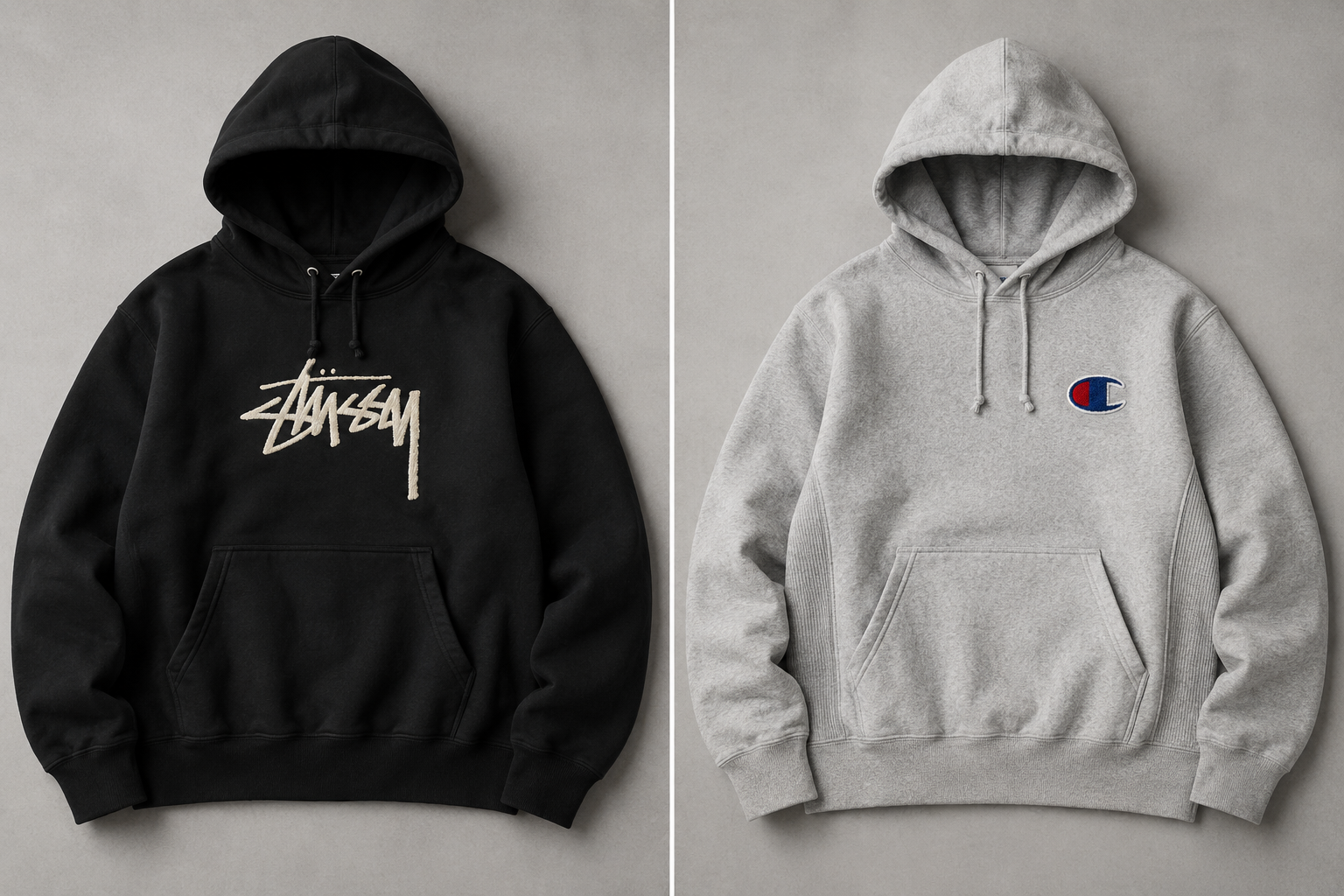
Stussy or Champion? It’s a fair comparison, but it’s not really an even one. These two brands sit in different lanes of the hoodie market, with different price points, different design philosophies, and different reasons to exist. The question isn’t which one is better in the abstract. It’s which one fits your wardrobe, your budget, and what you actually want a hoodie to do.
This page compares Stussy and Champion across the things that matter: fabric weight and construction, fit and cut, price, design language, and longevity. We handle Stussy daily and have owned multiple Champion pieces over the years, so the observations come from real-world use. For broader context on Stussy before you read further, our complete guide to Stussy hoodies covers fabric, fit, and history in depth.
By the end, you’ll know which hoodie suits your situation, and more importantly, when each one is the right buy.
Fabric and Construction: Both Solid, Different Targets
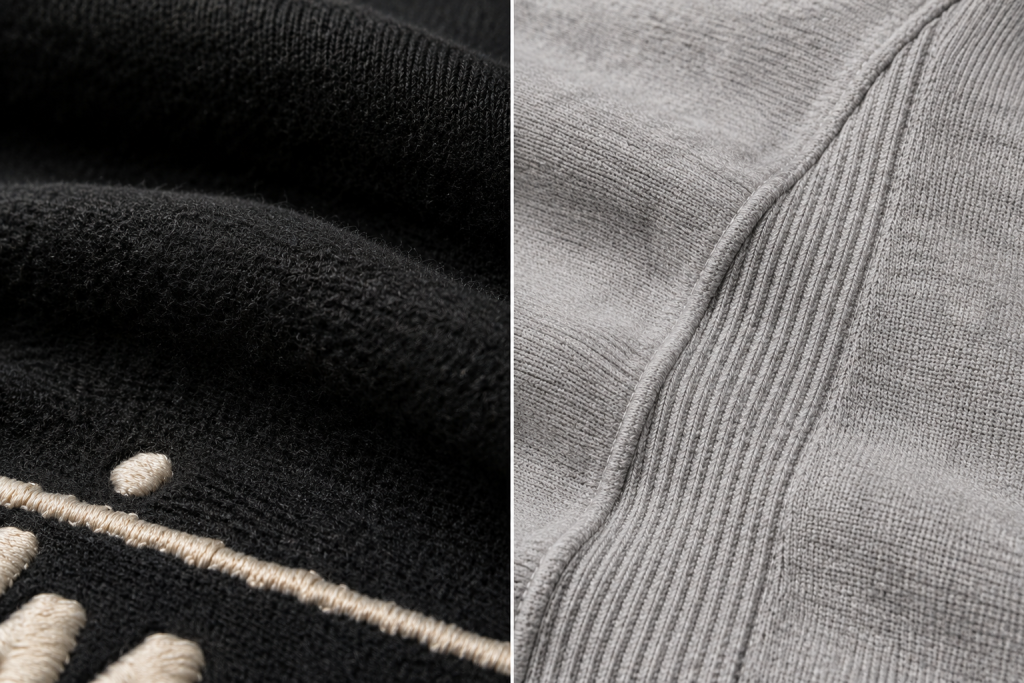
The Champion Reverse Weave is a legitimate classic for a reason. The fabric uses a horizontally-laid weave designed to resist vertical shrinkage during washing, which Champion patented back in 1938. The cotton fleece runs around 12 oz, with side panels of ribbed knit that allow the body to flex without distorting.
A Stussy basic logo hoodie uses 12 to 14 oz brushed cotton fleece, slightly heavier on the upper end. There’s no reverse weave construction, but the fabric is denser and the brushed interior feels softer against the skin. Both brands use flat cotton drawstrings, ribbed cuffs, and standard double-stitched seams.
Where they actually differ is hand-feel. A Champion Reverse Weave feels smoother and tighter against the body. A Stussy pullover feels heavier and more lived-in from the first wear. Neither is objectively better. They’re built for different priorities.
Print quality on Stussy embroidered pieces holds up better long-term. Champion’s chest logo is usually a small chenille patch, which can peel at the edges after a few years of regular wear. We’ve seen this on returned vintage Champion pieces.
Fit and Cut: The Real Difference
This is where the two brands diverge most clearly.
A Stussy Medium has a pit-to-pit chest of 24 inches, body length of 28 inches, and dropped shoulders. The cut is boxy and relaxed by design.
A Champion Reverse Weave Medium has a pit-to-pit chest closer to 22 inches, body length around 26 inches, and a shoulder seam that sits much closer to the actual shoulder. The fit is closer to the body, more athletic, and less draped.
In practice, a Champion looks tucked-in and tidy. A Stussy looks oversized and streetwear-coded even without trying.
If you want the relaxed streetwear silhouette without sizing up dramatically, Stussy gets you there in your true size. If you want a hoodie that fits closer for layering under a jacket or for a more athletic look, Champion does that better. For specific Stussy measurements before you pick a size, our breakdown of Stussy hoodie sizing has the full chart.
The Champion will not give you the dropped-shoulder streetwear look no matter how far you size up. The cut just isn’t built for it.
Price: The Gap That Defines Everything
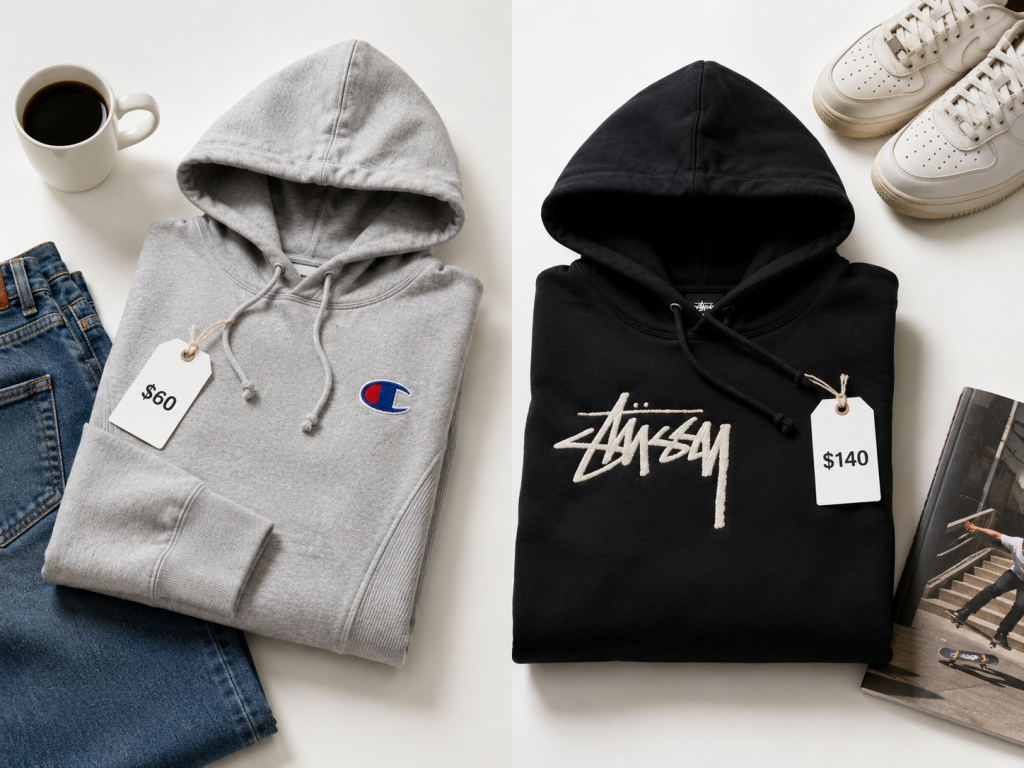
Here’s the honest part. A Champion Reverse Weave hoodie retails between $45 and $75 USD depending on colourway and retailer. Sales push it lower. You can buy one at most major department stores, sportswear retailers, and online.
A Stussy basic logo hoodie retails between $130 and $150 USD. Stussy operates as a single-brand operation with limited stockists and steady but smaller production runs.
That’s a 2x to 3x price difference. The fabric weight is comparable. The construction is comparable. So what are you paying for with Stussy?
You’re paying for the brand. The script logo. The cultural weight that traces back to Shawn Stussy in Laguna Beach, the International Stussy Tribe, and forty years of streetwear heritage. Champion has heritage too, but it’s athletic heritage, not streetwear heritage. The pieces are built and priced for everyday utility, not for cultural signal.
If you’re buying purely for warmth and fabric value, Champion wins on price every time. If you’re buying for the design language and what the piece says, Stussy is the only answer at any price.
Design Language: Sportswear vs. Streetwear
Champion’s design DNA is American sportswear from the early 20th century. Heritage athletic teamwear, university campus pieces, gym fundamentals. The brand worked with the US military, supplied college athletic departments, and built its reputation through utility rather than fashion.
Stussy’s design DNA is California surf-skate-hip-hop from the 1980s onward. The brand sits inside streetwear’s foundational history alongside names like Supreme and the broader culture documented by outlets like Hypebeast. The script logo, the 8-ball graphic, the relaxed fit, all of it was built for a different audience than Champion’s.
This shows up in how each hoodie reads in the real world. A Champion hoodie reads neutral. It doesn’t tell people anything specific about you. A Stussy hoodie reads coded. People inside streetwear recognise it immediately. People outside don’t notice it at all.
If you want neutral, Champion. If you want coded, Stussy. Neither is more valid. They just do different work.
For ideas on how to actually wear a Stussy piece across different outfits, our styling guide for Stussy hoodies walks through eight specific looks.
Longevity and Resale
A Champion Reverse Weave will last a long time if you treat it right. The fabric is durable, the construction is honest, and the patented weave really does resist shrinkage better than standard cotton fleece. Twenty years of wear is genuinely possible. Resale value, though, is minimal. A used Champion sells for less than retail in almost all cases.
A Stussy hoodie also lasts a long time, but the wear profile is different. The brushed fleece pills slightly faster on the interior. The print on screen-printed graphic pieces can crack if you tumble dry on heat. Resale on the basic line tracks close to retail, with Nike Stussy collaborations and pieces tied to Hiroshi Fujiwara, Comme des Garçons, or Dior holding stronger value over time.
For practical longevity, both win in different ways. Champion is more durable to abuse. Stussy holds its cultural relevance longer, which translates to resale value on the right pieces.
What This Comparison Won’t Help With
This page won’t help if you’re trying to decide between Stussy and Supreme. That’s a different comparison entirely, with much closer fabric specs and a wildly different price gap driven by hype rather than utility. Different decision, different article.
This page also won’t help if you specifically want a vintage Champion Reverse Weave from the 80s or 90s. The vintage market for Champion has its own pricing logic, its own authenticity rules, and its own collector community. New Champion and vintage Champion are practically different products.
And if your budget is under $30 for a hoodie, neither brand is the right fit. Mid-tier fast-fashion alternatives exist at that price, but you’ll feel the difference in fabric weight and durability within the first wash.
The Final Recommendation
For most buyers, the answer depends on one question: do you care about the streetwear coding?
Buy Champion if you want a durable, comfortable, athletic-cut hoodie at honest price, and you don’t care about brand signal. The Reverse Weave is genuinely one of the best value hoodies in the entire market.
Buy Stussy if you want the streetwear silhouette, the cultural weight, and the design language that comes with a forty-year-old heritage brand. Start with the classic Stussy basic logo hoodie and decide for yourself whether the price gap is worth it.
For our money, both deserve a spot in a serious wardrobe. A Champion Reverse Weave for daily use and abuse, a Stussy basic logo for when the outfit needs to say something specific. They’re not really competitors. They’re complements.