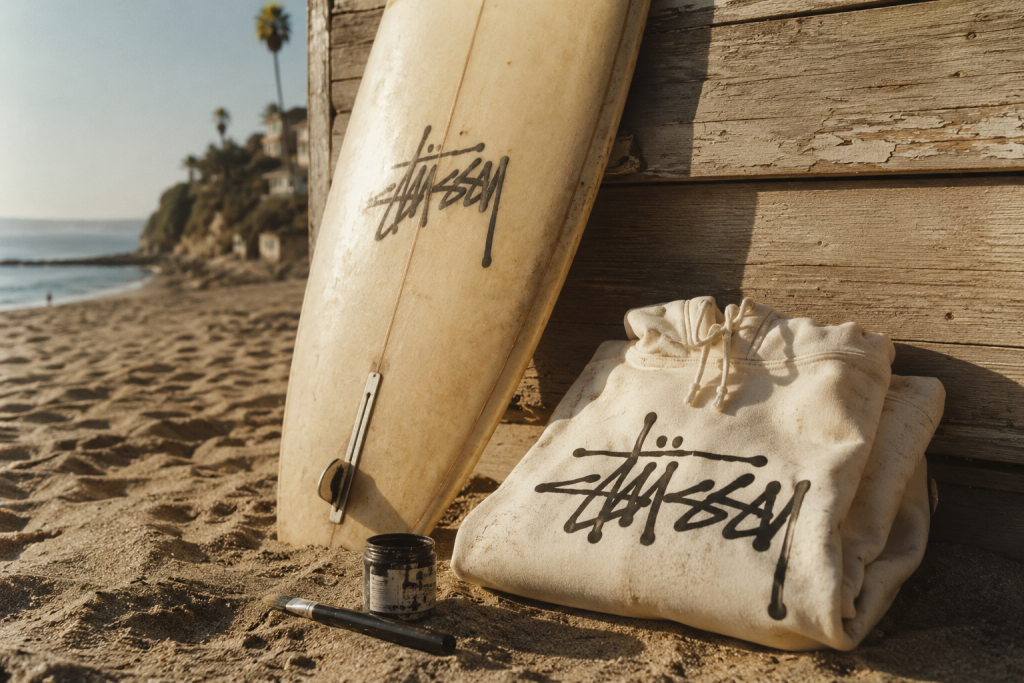
How did a surfboard shaper’s signature end up as one of the most recognised logos in global streetwear? That’s the question this page answers, focused specifically on the Stussy hoodie and its place in the brand’s forty-year evolution.
This isn’t a generic brand timeline. It’s a focused look at how the hoodie became Stussy’s signature piece, from its origins as practical surf-and-skate wear in early-80s Laguna Beach to its current status as a streetwear staple that connects Tokyo, New York, London, and every city in between. For broader context on the brand’s current lineup, fit, and styles, our complete guide to Stussy hoodies covers the present-day product range.
Stussy’s history matters because it explains why people still pay $130 for a basic logo pullover when cheaper alternatives exist. The cultural weight isn’t marketing. It’s earned, decade by decade, through specific moments and specific people. This page walks through them.
The Origin: A Surfboard Shaper’s Signature (1980 to 1984)
Stussy didn’t start as a clothing brand. It started as a surfboard label.
In the late 1970s, Shawn Stussy was shaping custom surfboards in Laguna Beach, California, and signing his work with a thick black marker. The signature, all caps with that distinctive slanted “S” and crossed “T,” became known among local surfers before it ever appeared on fabric.
Around 1980, Shawn started printing the same signature onto plain t-shirts, partly to promote the boards and partly because friends kept asking for shirts that matched the boards. He sold them out of his car at surf spots and small markets. The first pieces weren’t designed. They were practical. White cotton tees with the black signature across the chest.
The hoodie came later, but the logic carried over. Surfers and skaters in Southern California needed warm layers for cold dawn sessions and chilly evenings. Heavyweight cotton fleece hoodies, screen-printed with the same signature, became natural extensions of the t-shirt line.
By 1984, Shawn Stussy and Frank Sinatra Jr. (no relation to the singer) had formed Stussy Inc. and turned a side hustle into a proper brand. The signature was already iconic in a small circle. The hoodie hadn’t yet earned its central place, but it was getting close.
The International Stussy Tribe Era (1985 to 1994)
The single most important decade for Stussy’s cultural reach was the late 80s through the early 90s, when the brand built what came to be called the International Stussy Tribe (IST).
The IST wasn’t a marketing scheme. It was a loose network of friends, DJs, designers, and shop owners in cities around the world who Stussy gave free clothing to and informally appointed as cultural ambassadors. Members included Hiroshi Fujiwara in Tokyo (who later founded Fragment Design and shaped Japanese streetwear), James Lavelle in London (Mo’ Wax records), and dozens of others spread across global club, skate, and music scenes.
The hoodie became central in this era because it crossed cultures cleanly. Surfers in California wore it. Hip-hop crews in New York wore it. Acid house kids in London wore it. The same heavyweight pullover with the same script logo worked in every scene because each scene read its own meaning into it.
By the early 90s, the 8-ball graphic was introduced, tying into pool-hall and hip-hop visual culture, and added a second signature piece to the hoodie line. The 8-ball hoodie became almost as recognisable as the script logo version.
Outlets like Hypebeast have since documented this period as the foundational era of modern streetwear, with Stussy at the centre of it. The brand didn’t just sell hoodies. It built a network that taught other brands how streetwear was supposed to work.
The Shawn Stussy Departure and the 2000s Wilderness (1996 to 2010)
In 1996, Shawn Stussy left the company he founded. The reasons were a mix of creative fatigue and the standard founder-friction that hits most brands at scale. He sold his stake and walked away, leaving Frank Sinatra Jr. and the rest of the team to run the business.
The next decade was a strange one for the brand. Stussy kept making hoodies. The basic logo pullover stayed in the lineup. But the cultural energy slowed, and the brand drifted from the centre of streetwear conversation as newer labels like Supreme rose to dominate the 2000s scene.
The hoodies from this period are still well-made and the construction stayed consistent, but the design language got more generic. Pieces from the early-to-mid 2000s now read as transitional rather than iconic. We see them in resale channels occasionally, and they’re solid wearable pieces, but collectors generally treat them as the brand’s lower-tier era.
This stretch matters because it sets up why Stussy’s mid-2010s comeback felt so significant. The brand had something to come back from.
The Modern Revival (2017 to 2026)
The current Stussy era began roughly in 2017, when a cultural rotation back toward authentic streetwear, away from logo-heavy hype, started to favour brands with real heritage. Stussy had heritage. Supreme had hype. The conversation shifted in Stussy’s favour.
The hoodie was the centrepiece of this revival. The basic script logo pullover, mostly unchanged since the 80s, became a quiet status piece for people who knew what it represented. Younger buyers who hadn’t grown up with the brand discovered it. Older fans came back to it.
The Nike Stussy collaborations, starting heavily in 2020 and continuing through the current decade, pushed the hoodies into a new tier. The Comme des Garçons collabs added Japanese fashion credibility. The Dior partnership signalled that luxury fashion now recognised Stussy as a peer rather than a streetwear afterthought.
What you can buy at retail today, like the classic Stussy basic logo hoodie, connects directly to the pieces Shawn Stussy was screen-printing in 1982. The script is essentially the same. The cut is essentially the same. The fabric weight is essentially the same. That continuity is rare in fashion and is part of why the hoodie has held its cultural weight while many of Stussy’s contemporaries have faded.
This is a history of the brand and the hoodie’s place in it, not a buyer’s guide. If you’re looking for which specific Stussy hoodie to purchase right now, this isn’t the page for that.
This piece also won’t fully cover the vintage Stussy market for pieces from the original Shawn Stussy era. That collector world has its own pricing logic, authentication challenges, and dedicated forums. Early-90s IST pieces, especially anything tied directly to Hiroshi Fujiwara’s chapter or the founding US team, sit in a price tier that has more in common with rare records than with normal retail clothing.
And if you’re hoping for a clean, simple narrative where Stussy was always cool and always central to streetwear, the real history is messier than that. The brand had a wilderness period. It had founder departures. It had years where its hoodies sat unsold on shelves. That mess is part of what makes the current era earn its weight.
The Takeaway
A Stussy hoodie carries forty years of specific history. From Shawn Stussy’s signature on surfboards in 1980, through the International Stussy Tribe building global streetwear before the word “streetwear” existed, through the wilderness years and the revival, the hoodie has been the brand’s most consistent expression.
When you buy one today, you’re not buying a fashion item. You’re buying a piece of clothing that has stayed essentially the same shape, weight, and design for four decades, while the culture around it has shifted constantly. Whether that history matters to you is the only question that decides whether the hoodie does too.
For most serious streetwear buyers, the history is the point.