Pick up a Stussy hoodie for the first time and you’ll notice something off about it, in the best way. The shoulders sit lower than you expect. The body has more room than a standard pullover. The fleece feels denser, almost weighted, like the cotton was actually meant to last past two washes. That single tactile moment is why people who buy one Stussy hoodie tend to come back for a second, then a third.
This guide is for anyone trying to make sense of the brand before they spend money on it. Maybe you’ve seen the basic logo hoodie all over your feed and want to know if it’s actually worth the price. Maybe you already own a Champion or a Supreme piece and want to know how Stussy stacks up. Or maybe you just want to figure out which fit suits you, what fabric weights exist, and where to buy without getting burned by a fake.
We sell these hoodies, so we know which ones move, which ones sit on the rack, and which ones get returned because someone misjudged the cut. By the end of this guide, you’ll know the full landscape: the brand’s roots, the styles available, sizing logic, styling moves, care basics, how it compares to alternatives, and the questions buyers actually ask us before they check out.
A Quick Background on the Brand
Stussy started in Laguna Beach, California in the early 1980s. Shawn Stussy was shaping surfboards and scrawling his now-famous signature on them with a marker. That same scrawl ended up on t-shirts he sold out of his car, and the brand grew from there. By the late 80s the signature logo had become shorthand for a kind of style that didn’t exist yet: surf, skate, hip-hop, and punk pulled into one wardrobe.
The hoodie became a core piece almost by accident. Sweatshirts were practical for surfers and skaters, and Stussy’s heavyweight fleece felt right for both. By the 90s, the International Stussy Tribe (IST) had pushed the brand into Tokyo, London, and New York, with collaborators like Hiroshi Fujiwara and the Frank 151 crew shaping its cultural reach. That tribe model is partly why Stussy never felt like a corporate brand, even after it became a global one.
Today Stussy sits in an unusual spot. It’s older than most of the streetwear labels you’d compare it to. It has more cultural weight than most, but charges less than Supreme or Off-White. The hoodie, more than any other piece, is the one that carries that history forward. If you want the full story of how the brand got here, our deep dive on Stussy’s history covers the decades in detail.
The Main Hoodie Styles You’ll See
Stussy doesn’t release one hoodie. The lineup rotates by season, but most pieces fall into four recognisable categories.
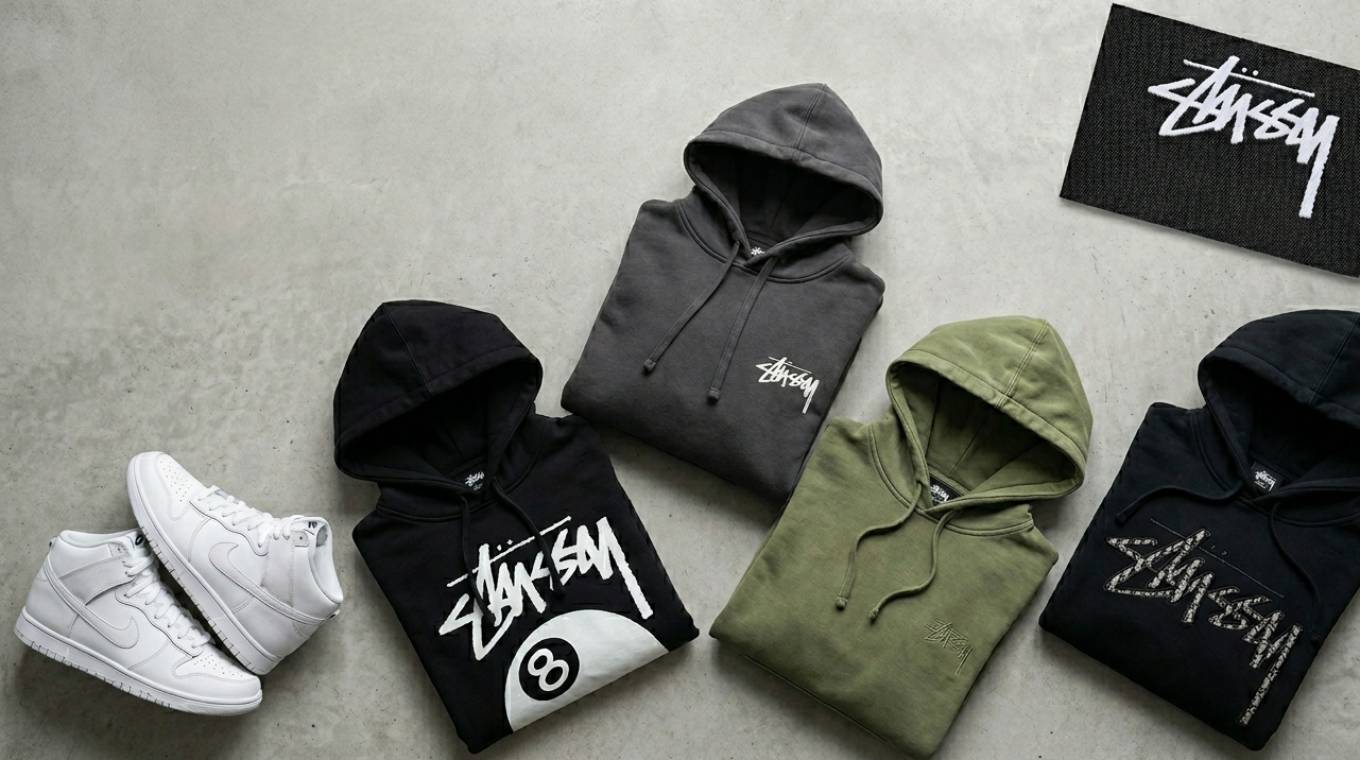
The Basic Logo Hoodie is the entry point. It’s a heavyweight pullover with the Stussy script across the chest, usually in a contrasting colour. Black, charcoal, cream, and navy are the staple colourways. This is the one most people start with, and the one we restock most often.
The 8-Ball Hoodie carries the brand’s pool-hall graphic, a circle-and-eight design that’s been part of Stussy’s visual language since the early 90s. It comes back in different colours each year, sometimes embroidered, sometimes printed.
The Pigment-Dyed Hoodie is for people who want a softer, washed-in look. The dye process gives each piece a slightly different finish, so no two are identical. Faded black, washed brown, and dusty olive are common.
Then there’s the Zip-Up Hoodie, which gets less attention but has a loyal following. The cut is similar to the pullover, but with a full zip and sometimes a higher collar. Useful as a layering piece in transitional weather.
Beyond these, you’ll find collaborations: Stussy has worked with Nike, Dior, Comme des Garçons, and others, and those hoodies tend to spike in resale value. They’re rarely on the shelf for long.
Stussy hoodies run boxy. Not extreme oversized, but noticeably roomier than a standard fit. The shoulder seam sits past your actual shoulder, the body is wider, and the length hits around the hip rather than tucking close to it. This is intentional. The brand’s silhouette has always leaned toward that relaxed, slightly draped look that came out of skate and surf wear.
Most pullovers use a 12 to 14 oz cotton fleece, which puts them on the heavier end of the streetwear spectrum. The inside is brushed for warmth. The cuffs and hem have ribbed knit, and the drawstrings are flat cotton, not the round nylon cord you see on cheaper pieces. Pigment-dyed versions feel softer because of the wash treatment, but the underlying fabric is the same weight.
Sizing is where most buyers get tripped up. If you’re between sizes and want the intended Stussy look, take your true size. If you want it more fitted (and yes, some people do, especially women buying men’s pieces), size down. If you want the fully oversized streetwear silhouette, size up. We see returns more often when someone sized up assuming Stussy ran small. It doesn’t. It runs true, with a relaxed cut built in.
The price range globally sits between roughly $110 and $180 USD for standard pieces, and collaborations push higher. If you’re new to the brand or unsure how their measurements compare to what you already own, ourfull breakdown of Stussy hoodie sizing covers chest, length, and sleeve dimensions for every fit.
How People Actually Wear Them
The Stussy hoodie works because it doesn’t demand a specific outfit around it. You can wear it three ways and it looks intentional in all three.
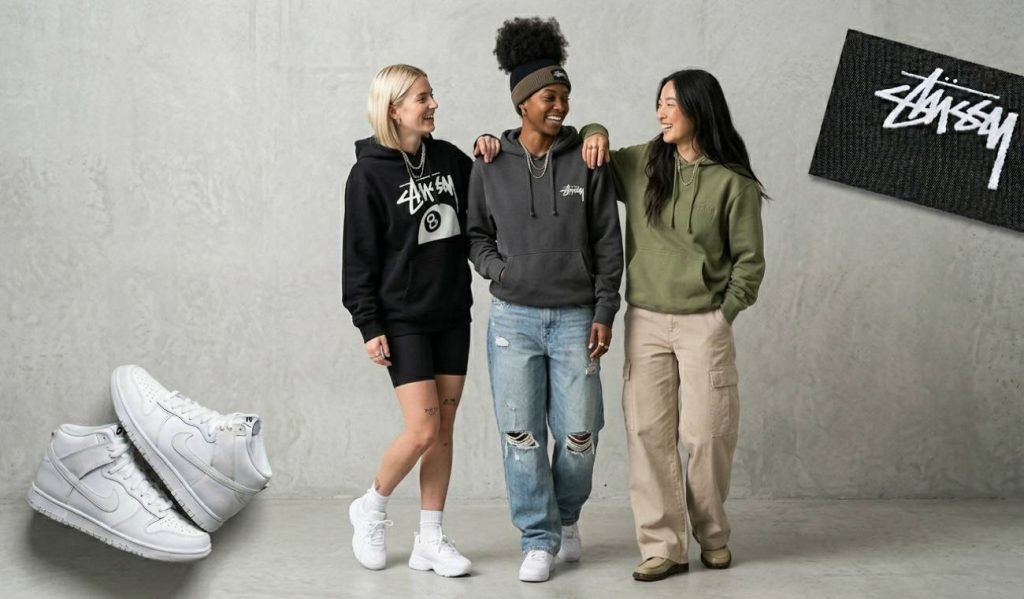
The classic move is full streetwear: hoodie with baggy denim or carpenter pants, a pair of skate shoes or chunky sneakers, maybe a beanie. This is where Stussy lives. The boxy cut and heavy fleece were built for this look.
The second move is layered. Hoodie under a leather jacket or a Carhartt-style work coat, slim trousers, and clean sneakers. The relaxed body of the hoodie keeps the layering from feeling stiff, and the script logo peeks through the open jacket without trying too hard.
The third is the unexpected one: hoodie with tailored pieces. Pleated trousers, leather loafers, a wool overcoat. It works because the hoodie is heavy enough to hold shape against tailoring instead of looking sloppy next to it. We’ve seen customers in their 30s and 40s pull this off well, particularly with the pigment-dyed colourways which read more grown-up than a stark black logo piece.
Women often buy men’s sizes for the oversized effect, pairing them with bike shorts, mini skirts, or wide-leg jeans. The brand makes specific women’s cuts too, but the men’s pullover has become unisex by default.
Heavyweight cotton fleece holds up well, but only if you treat it right. Wash inside out, in cold water, on a gentle cycle. Hot water will shrink the body and warp the rib at the cuffs. Don’t tumble dry on high. Either lay it flat or hang it over a wide rail. Hangers with thin shoulders will leave dimples in the fabric.
The print is the part that fails first. Stussy uses a mix of screen prints and embroidered logos, and the screen prints can crack after enough cycles in a tumble dryer. We tell customers to flip the hoodie inside out before every wash. That one habit doubles the life of the print.
Pigment-dyed pieces will keep fading slightly with each wash, which is part of the point. If you bought one for that lived-in look, lean into it. If you want it to stay closer to the original colour, wash less often and use a mild detergent without optical brighteners.
Pilling can happen on the inside of the fleece after heavy wear. A fabric shaver clears it in five minutes. The outside rarely pills if you wash it correctly.
How Stussy Stacks Up Against the Alternatives
The two brands people compare Stussy to most often are Supreme and Champion. They sit on either side of it in price and intent.
Supreme is the closer comparison. Both are heritage streetwear, both started in the 80s and 90s, both have heavy logo identity. Supreme hoodies usually retail at a similar or slightly higher price, but resale is where they pull ahead, sometimes dramatically. Quality-wise, Stussy and Supreme are close. The fleece weight is comparable, the construction is similar, and both run boxy. Supreme wins on hype. Stussy wins on availability, since you don’t need to win a draw to buy one. If you’re picking between them, ourStussy vs Supreme comparison lays it out point by point.
Champion is a different category. The Reverse Weave is a legitimate classic, runs about a third of the price, and the fabric construction is genuinely good for the money. What you don’t get is the cultural weight, the cut, or the design language. Champion is a great hoodie. Stussy is a piece with a 40-year story behind it. Whether that’s worth the price gap depends on what you actually want from a sweatshirt. Our Stussy vs Champion breakdown goes deeper on fabric, fit, and value.
For broader streetwear context, you can read about the history of the genre on Highsnobiety, which has tracked Stussy’s place in it since the 90s.
Off-White and similar luxury streetwear sit above Stussy in price and below it in heritage. Stussy’s edge is that it has been doing this longer than any of them.